


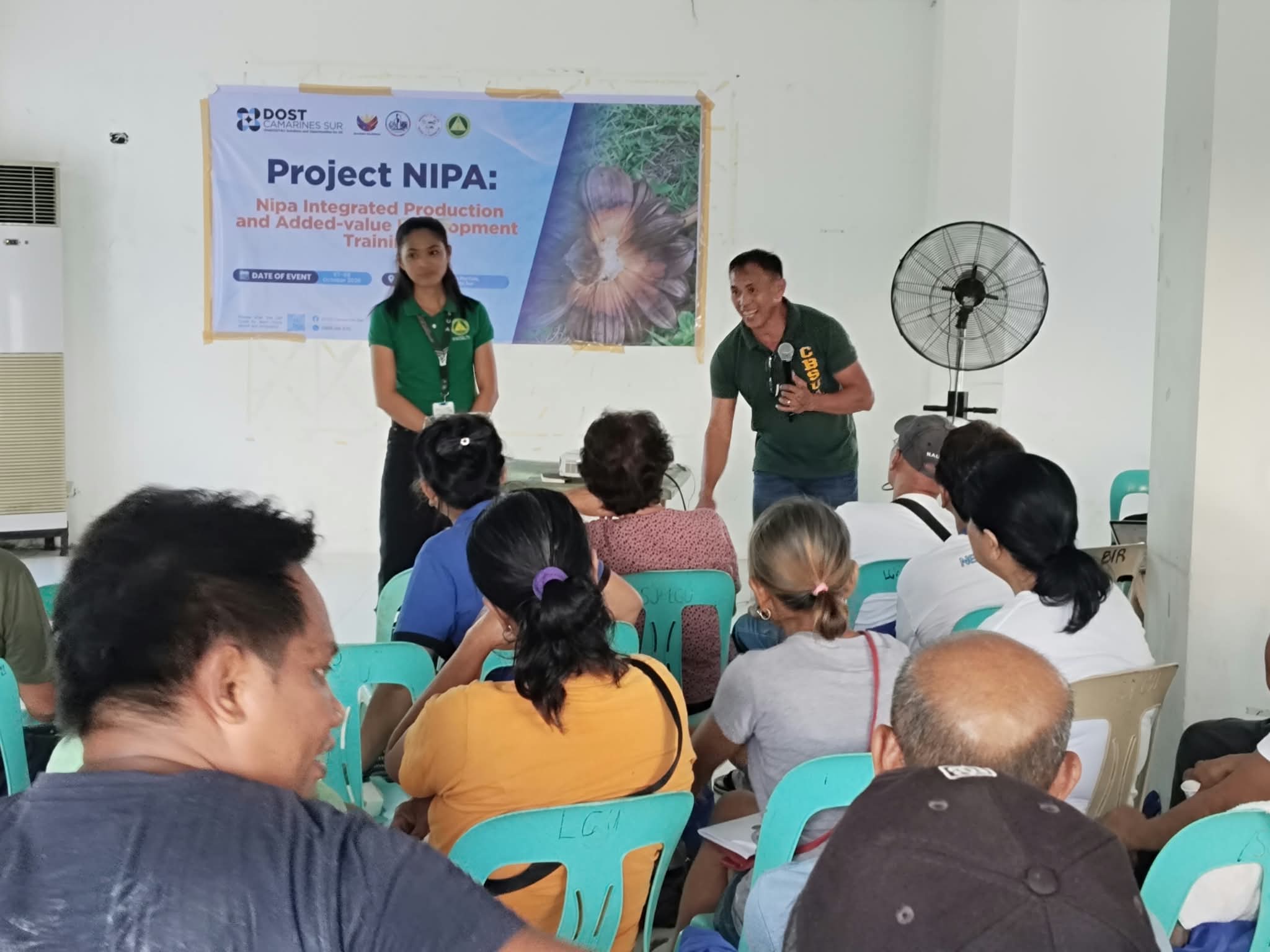
Local nipa harvesters in the municipality of San Jose, in the Partido area of Camarines Sur, are taking a step toward long-term livelihood growth with the rollout of Project NIPA: Nipa Integrated Production and Added-Value Development, held on October 7–8, 2026.
The initiative is a joint effort of the Department of Science and Technology (DOST) Camarines Sur, Central Bicol State University of Agriculture (CBSUA), and the Local Government Unit (LGU) of San Jose. It pairs field-level agricultural expertise with institutional support to show how coastal ecosystems can drive community-led economic development.
Instead of relying on low-yield collection methods, participating harvesters were introduced to science-based field management and sustainable extraction practices. The training began with the fundamentals. Mr. Sandy Rey Bradecina discussed nipa biology and its economic value, while Mr. Caryl Dioneda covered mature stand assessment, site selection, and seasonality. Mr. Francis Carlo Camata and Mr. Ariel A. Alemania then shared safety protocols and tool maintenance guidelines to prepare participants for proper field operations.
The technical component moved into hands-on field application. Ms. Lea Brutas Magtibay-Sedeño, Mr. Wilfred Subang, and Ms. Cherry M. Montalban guided participants through tapping mechanics, pre-conditioning, daily thin-slicing, and Good Agricultural Practices (GAP). These methods aim to increase sap yield without compromising the health and regeneration of nipa stands.
Ms. Magtibay-Sedeño and Mr. Subang also discussed post-harvest handling, including sanitation, container hygiene, filtering, and transport practices. These measures help reduce spoilage from premature fermentation and ensure high-quality raw material for processing.
Downstream processing, value-adding, and enterprise development formed the core of the program. Ms. Jennifer V. Perez trained local farming families in the commercial production of nipa vinegar, natural sugar, and syrup, helping primary gatherers become competitive micro-entrepreneurs with links to wider markets and institutional support.
The program closed with a synthesis and evaluation session and a hands-on community action planning workshop led by Mr. Salomon B. Azañes, Jr. Finally, Mr. Ronelo N. Loterte of the Dolo-Talisay Farmers Association delivered the closing message.
Through Project NIPA, participants left with both technical knowledge and actionable business strategies for building lasting, self-reliant local industries rooted in their coastal heritage. | 𝘙𝘦𝘱𝘰𝘳𝘵 𝘢𝘯𝘥 𝘱𝘩𝘰𝘵𝘰𝘴 𝘧𝘳𝘰𝘮 𝘔𝘢𝘳𝘭𝘦𝘯𝘦 𝘙𝘢𝘮𝘰𝘴