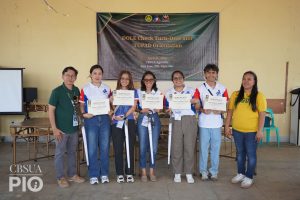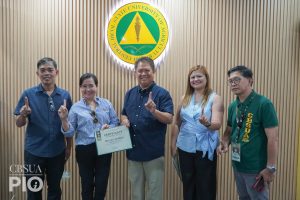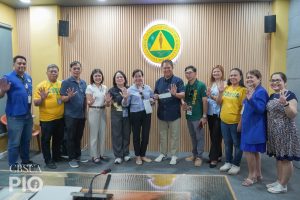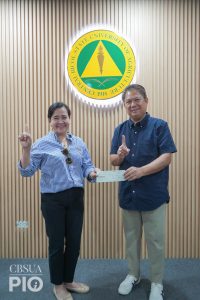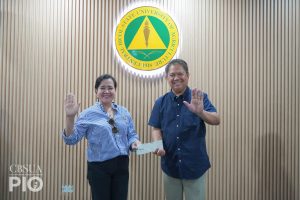

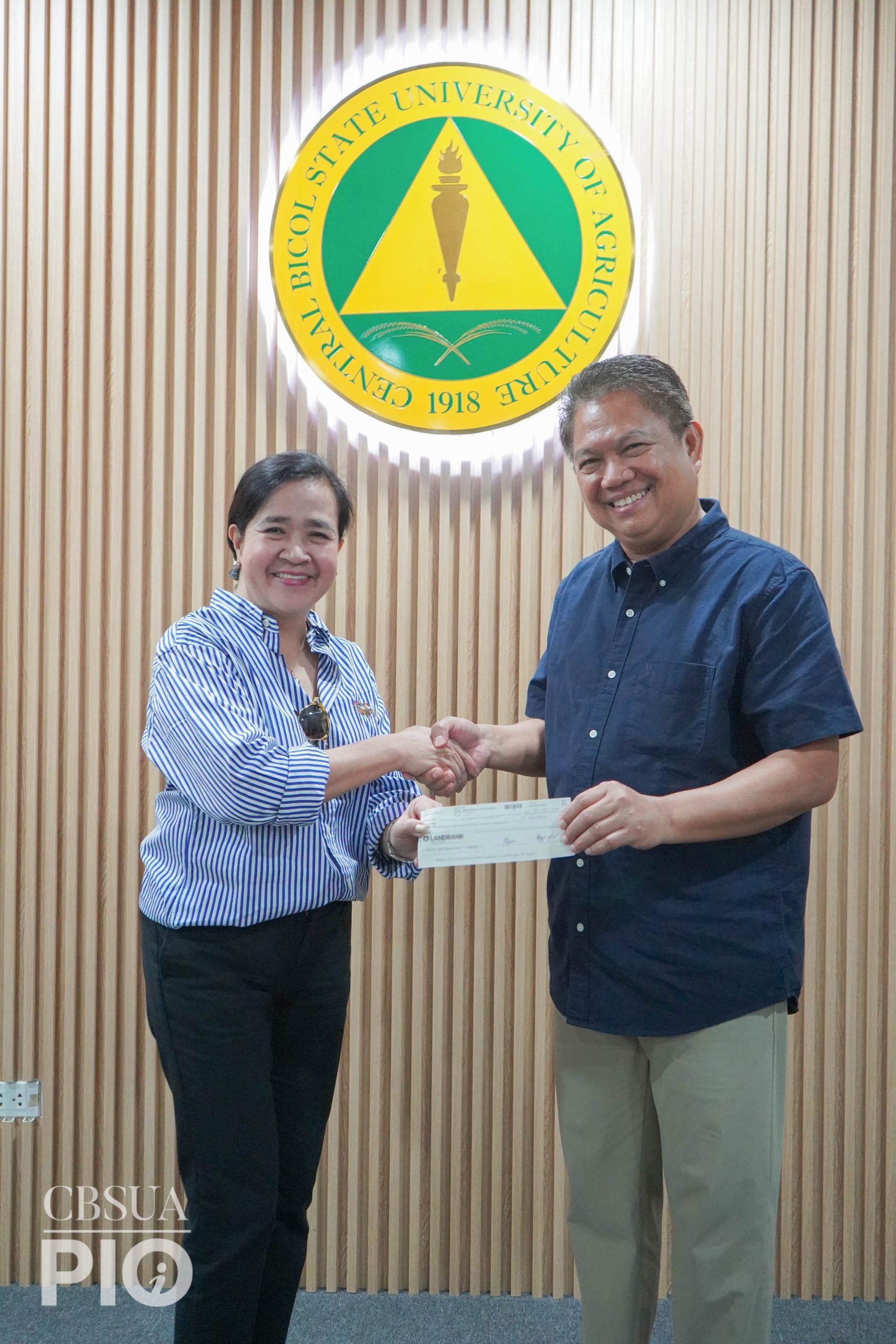
The Department of Labor and Employment Regional Office V (DOLE RO V) formally turned over a check worth Three Million Nine Hundred Fifteen Thousand Pesos (₱3,915,000) to Central Bicol State University of Agriculture (CBSUA) President Dr. Alberto N. Naperi on April 21, 2026 — wages earmarked for 100 beneficiaries of the Tulong Panghanapbuhay sa Ating Disadvantaged Workers (TUPAD) program, and a signal that one of Bicol’s boldest campus–community partnerships has moved from paper to practice.
The occasion, which unfolded in two parts across the CBSUA Board Room and the university’s Agriville, signals more than a financial transaction: it marks the operationalization of a partnership designed to let disadvantaged workers learn cutting-edge agrivoltaic skills while drawing government income support.
A Check and a Challenge
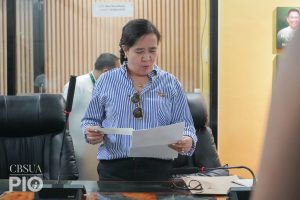
The formal turnover was held at 11:00 a.m. in the CBSUA Board Room, witnessed by key officials from both institutions — among them are Dr. Marife L. Pesino, Dr. Allan Del Rosario, Dir. Jill Rodriguez, Engr. Dulce Maria Abigail A. Jastio, Dir. Marlene A. Ramos, Dean Edmundo Casaul Jr., Mr. Harold Hernandez, and representatives from DOLE.
In her remarks, RD Gatinao described the funds as support for what the program formally tags as “CBSUA’s Agrivoltaic Farming and Skills for Green Jobs: Optimizing Land Resources for Dual Harvest of Food and Energy.” She articulated the program’s ambition plainly: that the 90-day TUPAD employment should translate into nationally recognized skills certifications in solar PV installation, carpentry, small metal arc welding, agri-crops production, aquaculture, fishing operations, and a range of cross-cutting competencies.
CBSUA President Dr. Naperi welcomed the partnership with a call for follow-through. He emphasized the importance of immediately building on the 90-day window and ensuring that students and beneficiaries connected to the program walk away with tangible, measurable takeaways. In the spirit of CHED’s ACHIEVE Agenda, he expressed hope that learning through programs like TUPAD would evolve into a lifelong practice — not a one-time intervention.
DOLE RD Gatinao echoed the sentiment, adding that TESDA would serve as the assessment partner — validating competencies developed through CBSUA-facilitated training — while DOLE handles wage disbursement. The three-way division of labor was clear: CBSUA trains, TESDA assesses, DOLE pays.
Engr. Jastio offered a practical call to action: connect the beneficiaries to actual employers. RD Gatinao acknowledged this as the shared challenge — guiding students to that point of employability is, she noted, the goal of the entire arrangement.
“Learn While You Earn, Earn While You Learn”
The program’s tagline captures its dual promise. Under TUPAD — an emergency employment program of DOLE — beneficiaries receive wages for a defined period while simultaneously undergoing structured training. There will be four (4) TESDA Courses that will be delivered throughout the 90 days program: (1) Solar PV NCII, (2) Carpentry NCII, (3) Welding NC II, and (4) Masonry NC II. Each course should have a minimum of 25 beneficiaries having a total number of 100 beneficiaries for this program.
At CBSUA, that training feeds directly into the university’s Agrivoltaic Project: a pioneering initiative that integrates solar energy systems with agricultural land use to achieve what the program calls “dual harvest” — producing food and energy from the same piece of land.
The partnership’s roots trace back to February 16, 2026, when DOLE RO V first visited CBSUA to discuss integration of TUPAD into the agrivoltaic framework. A formal Memorandum of Agreement was signed on February 19, 2026, at CBSUA Agriville, setting the legal foundation for today’s turnover. DOLE RD Gatinao called the collaboration a best practice worth documenting — a model that other state universities and colleges might replicate.
The Orientation at Agriville
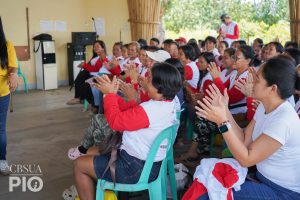
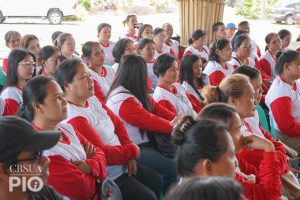
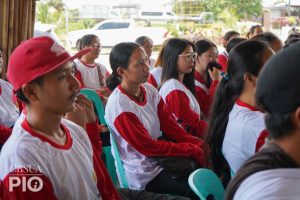
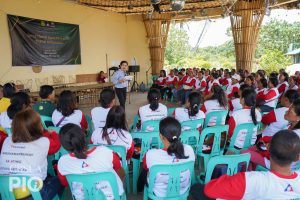
Following the turnover ceremony, the delegation moved to CBSUA Agriville, where the TUPAD beneficiaries — who had already received a preliminary orientation — gathered for the formal program. Her message there, however, was not merely administrative.
RD Gatinao delivered the keynote message, drawing from her own life story to ground the program in lived necessity. A native of Basilan, she recounted growing up amid conflict and economic scarcity, witnessing firsthand the poverty cycle that education — and government programs — can interrupt. She spoke of working through Lebanon’s conflict zones as a DOLE officer and of her conviction that the “war of life” demands the same resilience as any battlefield.
Her message to the beneficiaries was direct: TUPAD is a safety net, not a ceiling. In her own words: “TUPAD is a safety net. Kung may safety net, di ka babagsak agad.” It is emergency employment for displaced individuals — 90 days of income — but the skills they acquire open doors far beyond those 90 days. Occupational safety training embedded in the curriculum, she noted, means beneficiaries can also qualify as certified safety officers — extending their employment prospects well beyond agrivoltaic work.
The beneficiaries’ enthusiasm was visible. When asked by RD Gatinao whether they valued the opportunity, their response was an unambiguous yes.
Engr. Jastio subsequently facilitated the Agrivoltaic Program Orientation proper, introducing the project leaders and walking participants through the scope of the initiative.
Mr. Michael Angelo M. Neo, the Senior TESDA Specialist and the acting training specialist of the project, also facilitated the orientation on TESDA courses to be undertaken by the beneficiaries in this convergence.
What This Means for Workers, CBSUA, and Bicol
The TUPAD-Agrivoltaic integration positions CBSUA as more than a training venue — it becomes a living laboratory where state-sponsored employment, technical skills development, and innovative land-use science converge. The university’s land at Agriville is not just a campus feature; it is now a job site and a skills certification pathway for workers who might otherwise have no connection to higher education.
For DOLE V, the arrangement expands the reach of TUPAD into an area of national priority: green jobs and the renewable energy sector. For TESDA, it opens an assessment pipeline for emerging occupations. And for the 100 beneficiaries at the center of it all, April 21, 2026 marks the beginning of a paid 90-day program — one that, if the partners deliver on their shared vision, could reshape the trajectory of their working lives. | 𝘙𝘦𝘱𝘰𝘳𝘵 𝘧𝘳𝘰𝘮 𝘔𝘢𝘳𝘭𝘦𝘯𝘦 𝘈. 𝘙𝘢𝘮𝘰𝘴, 𝘋𝘪𝘳𝘦𝘤𝘵𝘰𝘳 𝘧𝘰𝘳 𝘜𝘯𝘪𝘷𝘦𝘳𝘴𝘪𝘵𝘺 𝘙𝘦𝘴𝘦𝘢𝘳𝘤𝘩 𝘗𝘶𝘣𝘭𝘪𝘤𝘢𝘵𝘪𝘰𝘯